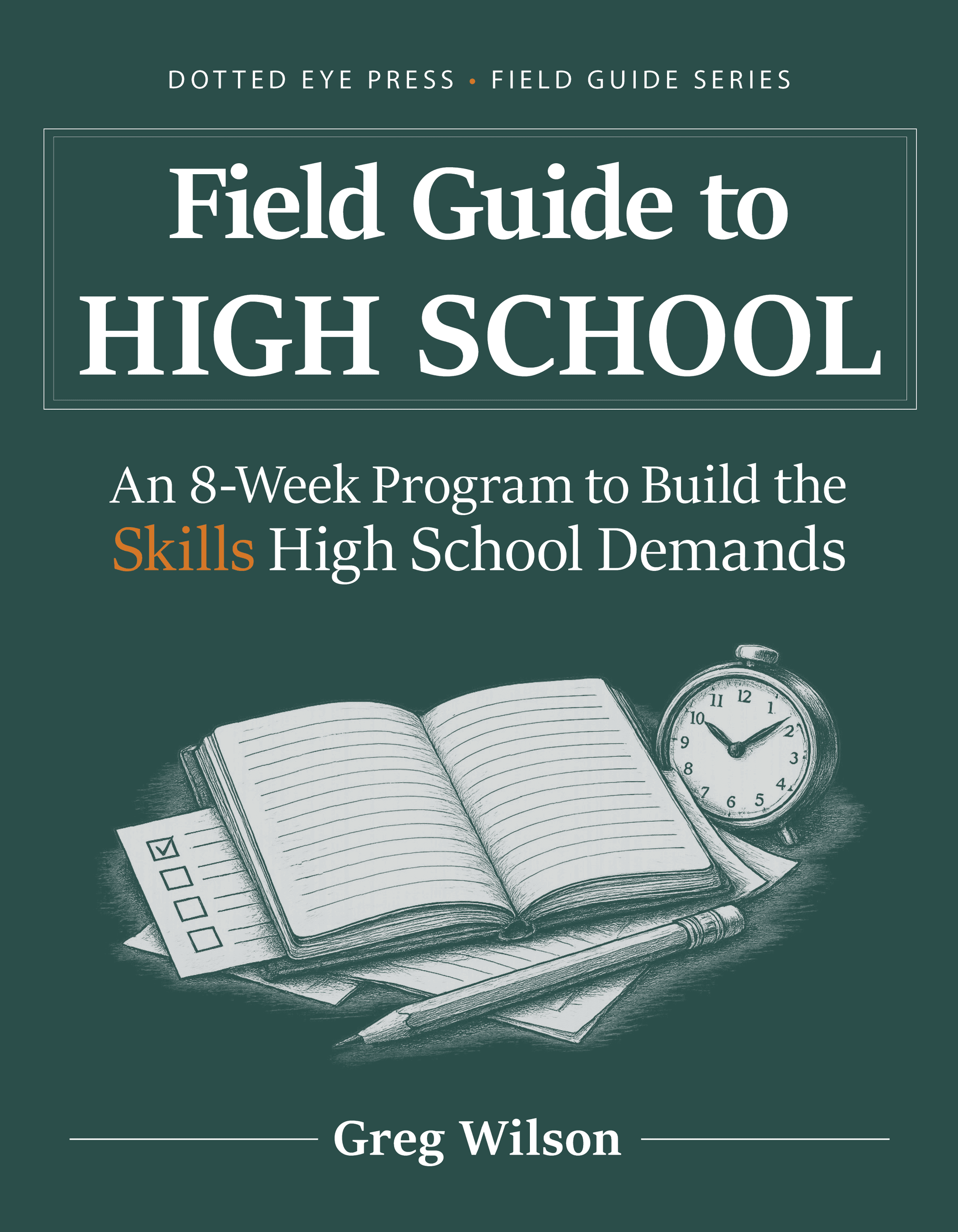
The Student Book
A daily program that teaches the part of high school no one teaches.
Eight weeks. Twenty to thirty minutes a day. By the end, your student owns a working system for planning, time, focus, and follow-through. Built directly with them, not for them. Written for the move from middle school to high school.
The week your student walked out of class confident, and got home Thursday night with a vague memory that something was due.
Almost every parent of an 8th or 9th grader has had this conversation. The teacher gave the assignment in class. Your student listened. They thought they had it. The week kept moving. By Thursday night the backpack is on the kitchen floor, the planner is empty, and the answer to "what was the assignment" is some version of "I think it was, like, the chapter? Or a worksheet? I'm not sure."
This is not a character problem. It is not laziness, it is not screens, and it is not a missing parental skill. It is what happens when high school assumes a student can plan, organize, capture instructions, manage time, and self-correct, and no one has actually shown them how. That gap is what this book is for.
Eight weeks. One small thing a day. A system the student builds, not one we hand them.
The Field Guide runs day by day. Each day stands on its own, takes twenty to thirty minutes, and closes with a "Your Turn" exercise the student writes directly into the book. They do not memorize a system we invented. They build one against the actual texture of their week, with their teachers, their assignments, their backpack, their kitchen counter.
The voice is direct. No lectures, no motivational asides. The book treats the student as a serious reader who can handle a real explanation of how their own brain works, then gives them something to try before the day ends.
Week by week the program builds from zero. By Week 4 the student is decoding instructions that come at them from three directions in one afternoon. By Week 8 the system is theirs.
The Eight Weeks
- 01Tiny Mistakes, Big MessesAwareness of how the brain processes and drops information. Self-observation and pattern recognition.
- 02Why Your Notes Don’t WorkActive capture systems: two-column notes, annotation marks, study pages.
- 03Where Your Time Actually GoesTime audits, backward planning from deadlines, weekly scheduling, priority decisions.
- 04When Instructions Have Too Many StepsTask decomposition, sequencing, calendar placement, recovery when plans break.
- 05Why You Forgot What You StudiedSpaced retrieval practice, self-testing, integration with existing routines.
- 06When Your Voice Needs to LandDeliberate pause, argument analysis, active listening, advocacy without conflict.
- 07See Yourself ClearlySelf-monitoring, evaluating what works, recognizing follow-through patterns.
- 08Integration & LaunchStress-testing the full system, building physical infrastructure, sustaining beyond the program.
What twenty minutes looks like.
Open the book to today's date. Read the day's lesson, which runs three to five pages and is written to be read once. Do the Your Turn exercise, which usually means writing four to eight lines directly into the book, sometimes a small experiment to run that day or the next morning. Close the book. That is it. The student does not need a parent next to them. They do not need a worksheet printed. They do not need a separate planner. Twenty minutes, the same time each day, every day for eight weeks.

It is not generic exercises. It is not a motivational book. It is not therapy. It is a daily skills program with exercises in every chapter, built on cognitive science, and the student does the work.
Who this is for.
This book is built for 8th and 9th graders, the students on either side of the move into high school. The year before high school is the moment the gap shows up: more teachers, more assignments, fewer reminders, no one watching whether the planner gets used. The Field Guide is written for that moment, and for the first months inside it.
The book is written to the student, not over their head and not down to them. A 7th grader can read it. A 9th grader will not roll their eyes at it. Families and educators follow along in the Adult Companion, which is the adult book in the series.
AVAILABLE IN
- Paperbackfull eight-week program, designed to be written in
- Ebookfor students who prefer to read on a tablet (Your Turn exercises stay in a printable companion sheet)
Field Guide to High School
Paperback $34.99 · Ebook $9.99
Looking for the adult guide? See the Companion →